

Keeping a goal because you’re embarrassed to change your mind can get expensive.
Before you make another plan for January, pull up the one you made for this year. Knowing what you know now, would you choose it again?
A hard week isn’t proof the plan is wrong. But if the evidence keeps pointing somewhere else, I want to be willing to change my mind.
That’s the question I keep coming back to: do I push, or do I pivot?
Some of your plans might be working. Some might need more time. And some might still be sitting there because you never decided what you were going to do on an ordinary Tuesday.
I’ve been thinking about the gap between having a big goal and knowing what to do next. This week, I want to give you a way to close a little of that gap: review the target honestly, make the next step clear, and stop rebuilding the same process every day.
Give your old plans an honest review
For me, Q4 is a chance to finish or reassess the plans for 2026 that I made in 2025. I’m looking toward Q3 2027 while preparing for Q1 2027 now, so January has something to build on.
That timeline works for how I’m planning. Larger organizations often need longer horizons because budgets and other teams’ work depend on one another. You can look years ahead and still check whether next week makes sense.
Dom Iacovone, Alex and Leila Hormozi, Greg Lav, and George Heaton have influenced how I think about this. The timeline is my own.
Here’s a simple review you can do with one plan today:
1. What did I say I wanted?
2. What evidence do I have that the current approach is helping?
3. Knowing what I know now, would I choose this again?
That last question can save you a lot of time. If the answer is no, write down what changed.
Marcus Aurelius makes room for correction in Meditations: if someone can show him that his thinking or actions are mistaken, he is willing to change. I like applying that to plans. You’re allowed to learn something after writing them.
“Strong beliefs, loosely held.” Commit to the work without pretending you can’t be wrong.
Also, don’t make the review a list of everything you did wrong. Matthew McConaughey has talked about journaling when life was going well and looking back for patterns. Ask what was happening during your better weeks. What did you make time for? What did you stop doing? What is worth trying again?
A good week is worth studying too.
And keep your judgment. I can respect someone’s work without putting them on a pedestal. In my faith, God is the only one who belongs above us. We’re all human. Learn what you can, then think about whether it fits the life you’re actually living.
A missed target can still show progress
I went into my first half marathon with two targets: 1:45 if things went really well, and under two hours as the safer goal.
My official chip time at the Columbia Gorge Half Marathon was 1:56:37. On a course with more than 1,100 feet of climbing, according to the organizers, I’m happy with that. Sub-two on those hills felt like a big deal.
The fun part was feeling the work show up. After tapering, my legs felt rested and the pace felt easy to hold. I was focused on running my own race. I’d grown my engine, and that preparation let me have fun and pass people along the way. It was definitely a scenic course. I always had a view.

The Gorge.
That’s what I was telling my brother Leo afterward. Missing 1:45 didn’t erase the training that got me under two hours.
You can use that distinction with your own goals. What were you aiming for? What actually happened? What improved along the way?
Keep the numbers honest. Then look at the whole result before deciding the effort was a waste. You might need a different approach, more time, or a harder question about whether you still want the goal. You won’t learn much by calling everything that falls short a failure.
Big plans are still welcome here. My buddy Tyas is one of those high-producing friends who pushes me. He broke Aptive’s company record as a rookie this year, too. We’ve been talking about having villas next to each other in Dubai when we can. Not a dream, a plan. We’re both dialed in, haha. Shoutout to @tyas.vaults.
The useful part comes after saying it out loud. What would we need to do this week to work toward it?
Make the next step easy to understand
Once you’ve picked a direction, make it clear enough that you could explain the next step to someone else.
“Get better at sales” leaves you with a lot to figure out every morning. “Prepare two relevant owner conversations, ask where work is getting stuck, and agree on a next step before ending each call” gives you something to do.
Now you have something specific to practice and review.
Patrick Lencioni’s work on organizational clarity asks what matters most right now and who is responsible. Those questions work outside a leadership meeting too. Pick the task, the person doing it (possibly you), and a realistic date. Then decide what will count as finished.
This is what I mean by “be the leader you want to see.” You can start with the promises and loose ends already in front of you.
Communication has levels. If something keeps going wrong, ask a little further than “Why didn’t you do it?” Was the expectation clear? Did the person have the skill, time, information, and tools? Repeating yourself louder won’t supply something that’s missing.
I wrote down a meeting idea the other day: everyone should bring questions beforehand, then compare notes so ten people don’t bring the same question. Although, honestly, if ten people have the same question, answering it once helps all ten. That might be exactly what the meeting should cover.
Sometimes the extra step I’m adding is the one I should remove.
Try this at your next meeting: bring the decision you need, the information that would help, and the question you haven’t answered. Leave knowing who does what next and when. You don’t need another meeting to admire how confusing the problem is.
The same goes for values. If you say you value communication, what would someone see you doing? Confirming the handoff, asking when something is unclear, following through when you said you would. Those are behaviors you can teach and notice.
Give recurring work a home
If the same issue keeps coming back, take a look at what happens immediately before it.
Suppose you keep forgetting follow-ups. Telling yourself to be more disciplined might help for a day. A small process gives you something you can repeat:
Before leaving a conversation, record the next action and its date in one place. When that date comes, review the context before reaching out. Afterward, record what happened and whether another step is needed.
Try it for five conversations. At the end of the week, check how many follow-ups happened when intended and where the process broke. That’s enough to start learning without building a whole department around it.
Choose a measure that answers the actual question. Your profit-and-loss statement shows revenue, costs, and profit. A follow-up list tells you whether you did what you agreed to do. Being busy doesn’t answer either question.
This is also where AI can be useful. Give an assistant a defined job, the information it is allowed to use, and a way to show you the result. Have it organize your call notes or prepare a follow-up draft. Check the facts before sending. Don’t give it private information it shouldn’t have.
Start with one repeatable task. See where it helps and where it needs supervision before handing it more.
I like the idea of being the conductor of your life. You shouldn’t need to play every instrument, but you still need to hear when something is off. A checklist or an AI assistant doesn’t remove your responsibility to check that the work happened.
Let the work give you something back
Another place to use this approach is your own learning.
If you’re busy and interested in a lot of things, capture one useful observation before it disappears. What happened? What did you think would happen? What would you try differently next time?
You can keep it in a journal. Or explain it to someone who is working through the same thing. Writing makes you notice the parts you don’t quite understand yet.
Last week’s blog has been proving a great investment of my time, sort of a sleeper investment I can’t lie.
One idea I’ve been learning about from Dan Koe is using a newsletter to develop your thinking, then taking useful parts into shorter posts. Instead of inventing a completely different idea for every platform, work through one properly. A question from a reader can give you something to investigate next.
For example, that five-conversation follow-up test could become a short note about what you tried, what got in the way, and what you changed. Someone else gets a practical starting point. You get a clearer understanding of your own process. You can share what you’re learning without pretending to have it all figured out.
If you want to publish, give writing a place in the week. Keep a journal and pen or a laptop nearby for ideas, then choose which ones deserve the reader’s time. Leave other people’s private situations out of it.
Ask what matters, then try something that helps you find out.
Something you can use before January
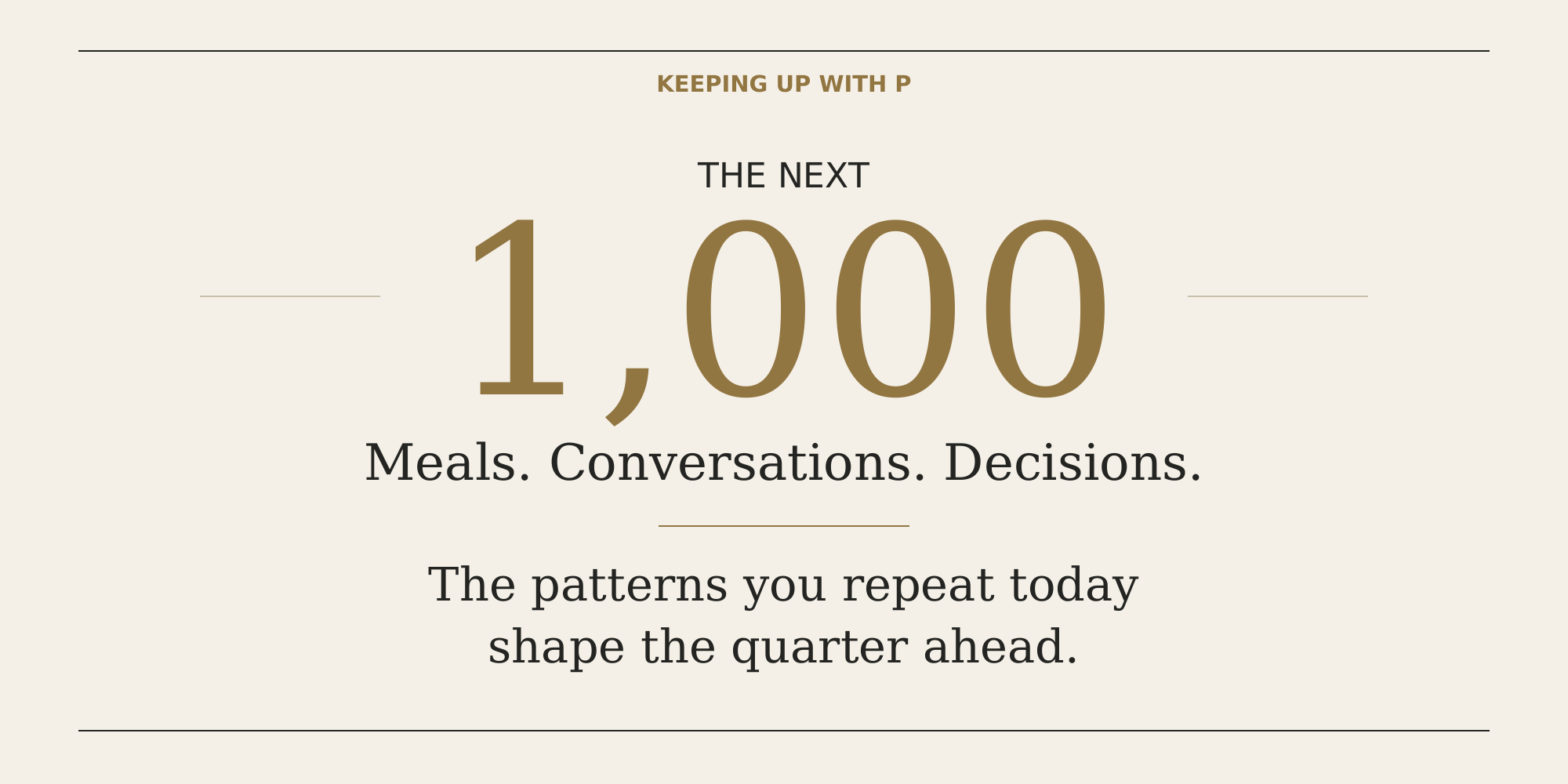
The Next 1,000 graphic gets at the same idea. A version was shared by Scott D. Clary, and I read its numbers as a metaphor for repeated choices, not scientific claims about what a certain number of actions will do to your health or money.
A single choice can feel small because it is small. The interesting question is what happens when it becomes the choice you keep making.
Before you close this, take ten minutes with one plan:
Keep it, change it, or stop it. Write one sentence explaining why.
Choose a direction for Q3 2027, then name one thing you could put in place now to make Q1 easier. Give that step a date and decide when you’ll review it. Keep the scope small enough to actually finish.
If you run a business, that might be a cleaner follow-up process, a clearer handoff, or a way to see whether work is getting completed. Sometimes people don’t want the label. They want the outcome.
That’s the work I’m building Gradatim around. If you’d like another set of eyes on one recurring process, the selective free 14-day review provides three priority findings and a practical roadmap. Implementation is separate and paid. You can learn more or apply at gradatimconsulting.com.
If you ever meet a business owner who could use that help, you can introduce us. Our referral offer is up to $5,000: $2,000 after we collect payment for their first implementation, and $3,000 if that same customer agrees to and pays for a separate second implementation. Two installments on one implementation don’t count as two implementations.
Introduce us, or have the owner put your name in the application’s referral section. You don’t need to sell our services. An introduction by itself doesn’t earn a payment.
If the skill you want to build is sales, I’m also putting together a door-to-door team. Message @pfranco06 if you want to talk about learning and working alongside me. I’d rather have that conversation than leave you guessing what the opportunity is.
Whatever you’re building, I hope you leave this with one thing you can use. That’s what I want Field Notes to be worth showing up for each Friday at 9 a.m. Pacific.
Work step by step, marginal improvement leads to excellence.
What could you prepare this week that would make January easier?
Pedro